


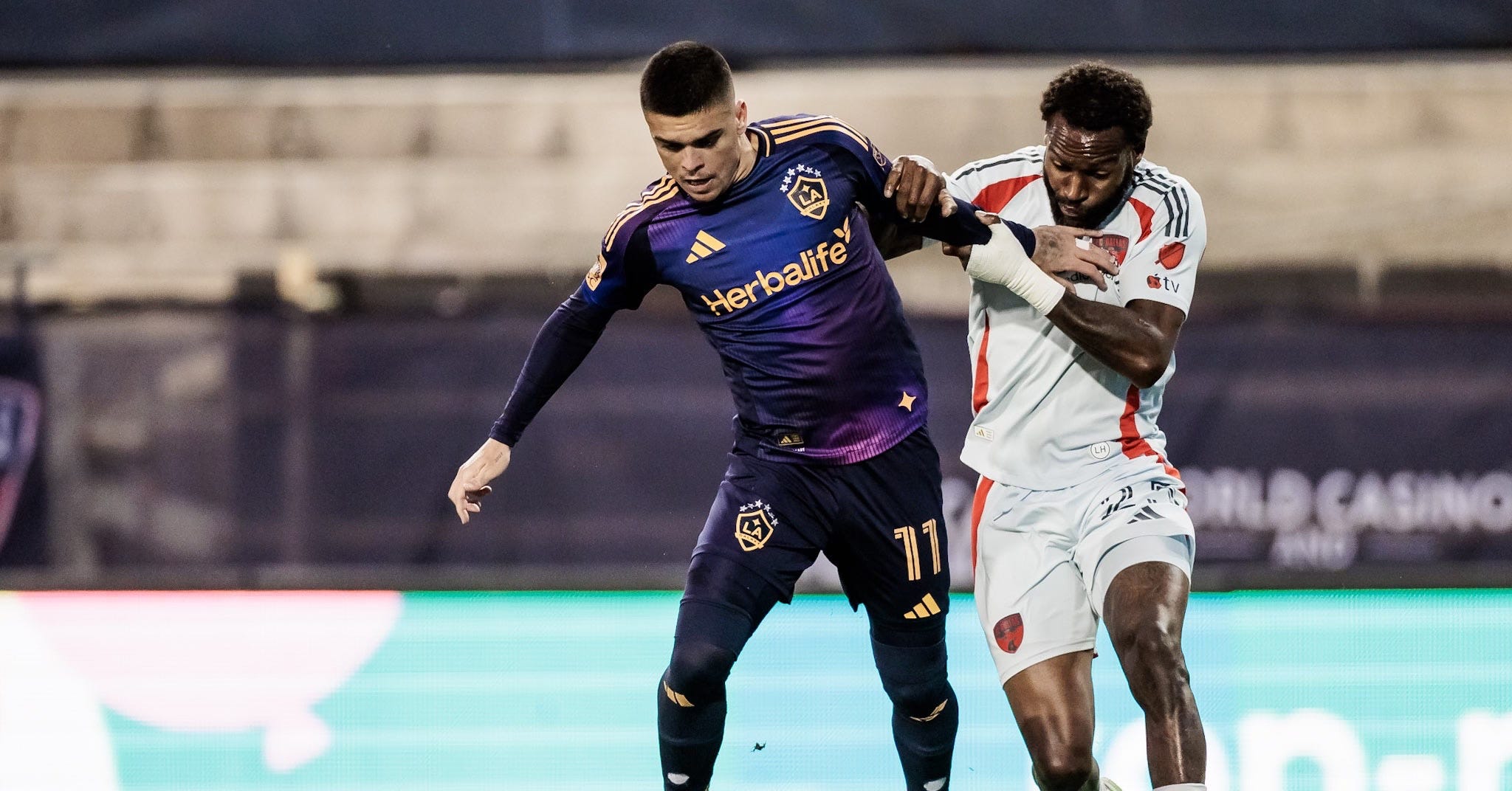
Football is a game where one tactical switch can win or lose the match.
It rescued a point for the LA Galaxy on Saturday night and avoided what could’ve been a demoralizing loss to start a tough road trip. The 2-2 draw with FC Dallas isn’t the ideal result, but given the circumstances of the match, the Galaxy will take it.
For the second straight MLS match, the LA Galaxy lined up with a back three and played in a 3-4-3 shape to start the game. After 38 minutes, LA was down 2-0 due to Maya Yoshida's blunder and Dallas taking advantage of the G’s failing to mark runners in the box.
Following the second goal, Head coach Greg Vanney reverted to a 4-3-3 shape – one that LA is extremely comfortable with. The Gs looked livelier on the ball, and it made it easier for the team to get past the press of FC Dallas. In the 30 minutes LA played in the 3-4-3, it was clear that this system isn’t going to work in the long term.
Let’s dive into the blueprint for why the back three hindered the LA Galaxy in Dallas.
Why the Back 3 Failed
The front three of the 3-4-3 have very different roles compared to the 4-3-3. For starters, Gabriel Pec and Joseph Paintsil didn’t play as wingers but rather as half-space number 10’s that had the freedom to combine.
This means it was very important for the back three and midfielders to progress the ball into attacking areas and give the front three the opportunities to combine and open spaces. This means Edwin Cerrilo and Lucas Sanabria were too key to ball progression. They determined the moment the ball was played to either the wingbacks or dual 10’s.
Dallas understood that and allowed for the two midfielders to get touches on the ball and block passing lanes in order to force turnovers off bad balls.
In this clip here, watch how Dallas looks to cut off passing lanes the moment that Cerrillo gets on the ball. His pass is cut off, and Dallas forces LA to play a hopeful long ball to create offense.
A lot of responsibility is on the two central midfielders to keep possession and get the ball moving towards the goal. A key aspect is understanding the movement of the wing-backs and two 10’s playing the half-space. When there is no chemistry when it comes to anticipating your teammates’ run, that’s where the game gets sloppy.
That’s what happened in this play here. Sanabria anticipates Pec to come inside toward him, but instead, he makes a run in behind, and Dallas wins the ball with momentum. You can even see Vanney at the bottom of the screen showing his displeasure with that lack of understanding.
Here’s the other thing about this playstyle: it takes away from the dynamism of Pec and Paintsil.
When both players are forced to play more technically and focus more on combining with the midfield, it takes away the vertical threat they possess, which is still one of the best in the league.
This moment here is why Vanney pushed away from this system in the first half.
Gabriel Pec gets a touch of the ball with his back to the goal rather than moving forward. I know for a fact this is where Vanney doesn’t want to see Pec in possession.
He loses the ball easily because of the Dallas press ready to engage in the midfield, and it leads to a goal. Aside from this being another goal for Dallas, seeing Pec in position with the ball must’ve been the final straw for Vanney playing in this system.
“I thought we’d have a better time with some of our movements to be able to break their pressure and try to get Joe, Gabe, and Joao a little closer together. And we just weren’t able to break the initial pressure, and they just kept coming, and we were having a hard time finding time to set up our attacks and get to those guys clean.”
- Greg Vanney on why he switched to the back four
Getting the most out of Paintsil
With Paintsil, playing as 10 or in the half space is not the way to get him to impact games. He excels in motion and dribbling forward. He has the pace to beat any defender, and his runs in behind are his specialty.
When you force Paintsil to slow down and play in tighter spaces rather than attack open space, he becomes pedestrian. Compared to Pec, Paintsil just lacks the technical ability to be great in combination play and play under pressure.
For Sanabria’s goal, Paintsil takes on his man and is constantly moving towards the goal with and without the ball. Sanabria does well to score, but this shows how important it is to get Paintsil moving with the ball towards the goal.
For his goal, this is a classic attacking space finish. The Galaxy force movement between the Dallas backline and Paintsil reads the moment to attack a gap in the backline. With LA starting to combine down the right more, Dallas starts to float more towards that side. Paintsil roams near the top of the box and Pec players a killer ball for Paintsil to finish with a powerful shot.
Paintsil was the reason for LA getting a point from this game. He’s dynamic and gives the Galaxy attack that extra dimension in the moments he’s playing into space rather than within it. It’s hard to envision Paintsil having this same effect had Vanney not made the tweak to revert to the usual formation.